
The Call That Changed Everything
By Karl Marshall – reflecting on his journey to Antarctica, fifty years later.
People often ask how I ended up at the South Pole.
The truth is, there was never a grand plan.
I was simply the 3M technician in Christchurch who looked after copiers.
One Monday morning in January 1975 the telephone rang. The United States Navy wanted to know if I could travel to Antarctica to repair one of their machines. My answer was probably something like, "How much notice have I got?"
Within days I'd been rushed through a medical, handed a mountain of extreme cold weather clothing and found myself climbing into the back of a Hercules aircraft. Everything happened so quickly that I barely had time to understand where I was going. Only the day before, two aircraft had been involved in accidents on the ice, yet somehow none of that seemed quite real. I simply had a job to do.
Eight and a half hours later the Hercules landed on skis at Williams Field.
I still remember stepping out into the Antarctic air for the first time. It was unlike anything I'd ever experienced—cold, crisp and impossibly clear. I remember thinking, "Well... I've arrived at the world's last frontier."
McMurdo Station was a remarkable place. Hundreds of scientists, engineers and support staff lived together in what looked more like a construction camp than a town. Everything depended on everyone else. Every litre of fuel, every meal, every spare part had travelled thousands of kilometres to get there.
My job was wonderfully ordinary.
I serviced copiers.
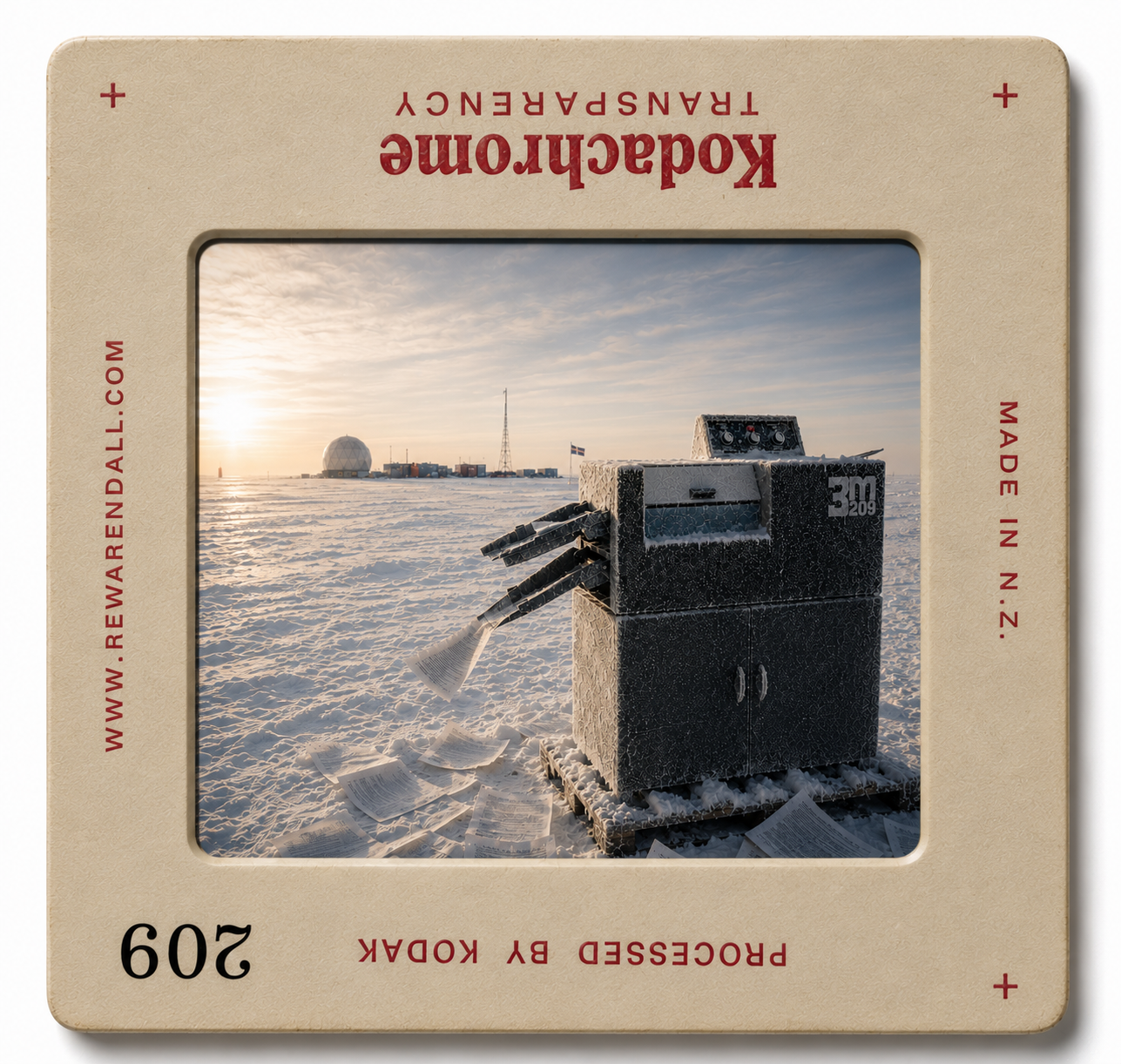
There were six Model 209 copiers scattered around McMurdo and a couple of smaller machines as well. I suspect very few people gave them a second thought until they stopped working. They quietly produced reports, scientific notes, weather observations, engineering drawings and messages that kept the station operating. My job was simply to keep them doing that.
Looking back now, I realise those machines were far more important than I understood at the time.
On my day off I wandered up Observation Hill and visited Scott's Hut. Standing inside that little timber building, surrounded by the belongings of men who had passed through decades earlier, I felt history sitting quietly beside me. Antarctica has a way of making you feel very small, yet strangely connected to everyone who has stood there before.
A few days later someone asked if I would fly to the South Pole itself to service another 209.
There was only one sensible answer.
During the flight over the Transantarctic Mountains I sat in the cockpit wearing headphones, listening to Mantovani on a cassette player while the most extraordinary landscape unfolded beneath us. Even today that sounds surreal, but that's exactly how I remember it.
The South Pole Station was astonishing.
Every nut, every bolt, every sheet of plywood, every drop of fuel had been flown in. Everything depended on engineering, planning and people working together. The temperatures were beyond anything I had ever imagined, yet life continued because thousands of small jobs were done properly.
Mine was one of them.
I repaired the 3M 209 copier.
Then I flew home.
From today's perspective it almost sounds unbelievable. I answered a phone call on a Monday and, before the week was over, I'd been to the South Pole and back again.
At the time it simply felt like another service call.
Only later did I realise how fortunate I had been.
I often say I was just in the right place at the right time, and that's true. But I also think life sometimes rewards people who are willing to say "yes" before they know exactly where the journey will lead.
I didn't go to Antarctica to become an explorer.
I went because a copier needed servicing.
Fifty years later, the 209 copier has returned to tell a different story—one that reminds us that history isn't made only by famous explorers. Sometimes it's made by the people quietly keeping everything running in the background.
I'm grateful I answered the phone.
I had no idea I would end up at the South Pole..
— Karl Marshall, 3M Technician & accidental South Pole explorer 1975.

karl//
Every story matters.
Karl's story is just one page.
Leave your page, and help keep the heartbeat of Antarctica alive for future generations.
Someone, someday, may discover it.